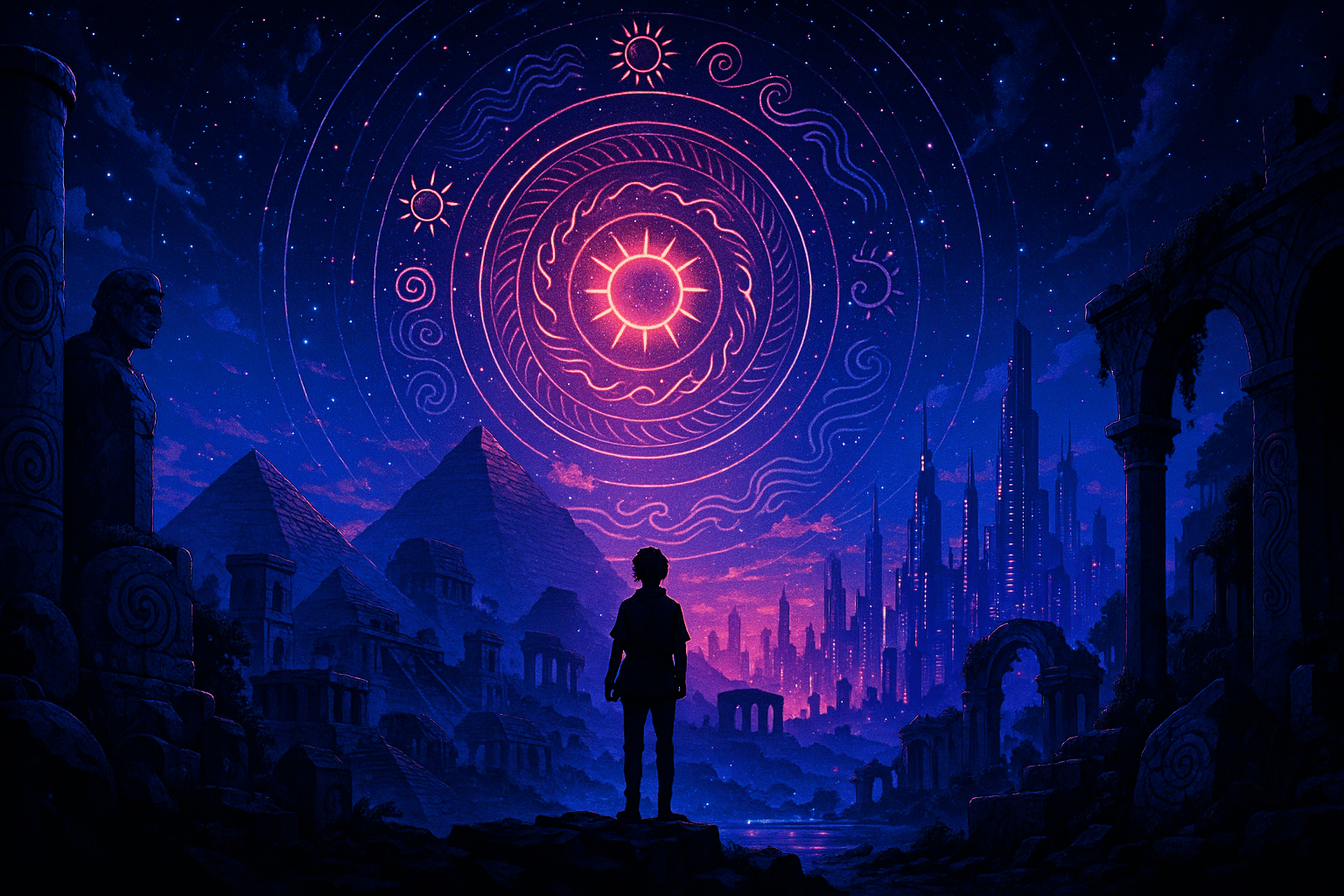
What If Humanity Has Reset More Than Once?
You’ve heard these stories a thousand times.
But what if you haven’t been reading them as history…
You’ve been reading them as patch notes from previous versions of humanity.
The Patch Notes Theory
Here’s a thought experiment:
Open any mythology textbook. Read the creation stories side by side — Sumerian, Greek, Hindu, Norse, Aztec.
Notice anything?
They don’t read like “origin myths.”
They read like patch notes from previous builds of civilization.
- Flood myths on every continent
- Cycle-of-time cosmologies
- Civilizations that “fell” and were “forgotten”
- Golden ages followed by catastrophic resets
This isn’t poetic coincidence.
It’s a narrative pattern repeating across cultures that never contacted each other.
What if it’s not metaphor?
What if humanity has restarted multiple times… and the stories we dismiss as “myths” are the only data that survived the wipe?
Let me show you why this idea refuses to die.
Evidence #1: The Flood Story That Won’t Stop Repeating
Almost every ancient culture on Earth has a flood story.
Not “similar” flood stories.
Identical flood stories.
The Plot
- Humanity becomes corrupt / arrogant / broken
- Divine or cosmic forces decide to wipe the slate clean
- One person (or a small group) is warned
- They build a vessel, climb a mountain, or find a way to survive
- Everything else drowns
- Humanity restarts from the survivors
The Cultures
- Sumerian: Atrahasis survives in a boat (predates Noah by 1,000+ years)
- Hebrew: Noah and the ark
- Greek: Deucalion and Pyrrha repopulate after Zeus floods the world
- Hindu: Manu is warned by a fish and survives the deluge
- Norse: Bergelmir escapes in a hollowed tree trunk
- Aztec: Nahui-Atl (the fourth sun) ends in catastrophic flooding
- Chinese: Gun-Yu and later Yu the Great battle immense floods
- Native American: Dozens of flood legends across different tribes
Different continents. Different languages. Different gods.
Same script.
Why This Matters
Mainstream explanation:
- ✘ “Humans lived near water, so they experienced floods, so they made up flood stories.”
Cool theory. Except:
- These myths don’t describe local river floods — they describe global annihilation
- The details are too consistent (warning, vessel, animal preservation, restart)
- Cultures with no known contact share plot beats down to minor specifics
Alternative explanation:
This isn’t folklore. This is memory bleed from a previous version of humanity.
The story keeps repeating because something like it actually happened.
Evidence #2: The Obsession With Ages and Cycles
Ancient cultures didn’t see history as a straight line.
They saw it as a loop.
Greek: Hesiod’s Five Ages
Hesiod described humanity living through distinct ages:
- Golden Age — humans lived like gods
- Silver Age — decline begins
- Bronze Age — war and violence
- Heroic Age — brief renaissance
- Iron Age — corruption and decay (our current age)
Each age ends. Then the cycle resets.
Hindu: The Yugas
Hindu cosmology scales the cycle to millions of years:
- Satya Yuga (Golden Age) — 1.728 million years of truth
- Treta Yuga — virtue declines by 25%
- Dvapara Yuga — virtue declines by 50%
- Kali Yuga (our age) — virtue at 25%, chaos reigns
After Kali Yuga?
The cycle resets. We loop back to Satya Yuga and start again.
Norse: Ragnarök
The Norse didn’t believe in one apocalypse.
They believed in cyclical apocalypse.
Ragnarök destroys the world, kills the gods, burns everything…
And then two humans survive (Líf and Lífþrasir) and restart civilization.
The Pattern
This isn’t “progress toward utopia.”
It’s:
Start → Rise → Peak → Corruption → Collapse → Reset → Repeat
Like a roguelike game where each playthrough starts fresh but echoes the last.
Evidence #3: Languages That Appear Fully Formed
Here’s where archaeologists get uncomfortable.
Some of the oldest known languages just… appear.
No evolution.
No proto-versions.
No obvious “learning curve.”
Sumerian
- One of the first written languages
- Shows up around 3400 BCE already complex
- No earlier “simple” version exists
- Immediately used for astronomy, math, law, and administration
Sanskrit
- Appears fully developed with intricate grammar
- Linguists call it “too perfect” for a naturally evolved language
- Contains philosophical and metaphysical concepts from the start
Proto-Elamite
- Appears suddenly in Iran around 3200 BCE
- Remains undeciphered
- No clear linguistic ancestors identified
Old Egyptian Hieroglyphs
- Emerge fully functional around 3200 BCE
- Already capable of recording complex religious and governmental ideas
- No obvious “practice run” system has been found
Why This Is Weird
Languages are supposed to evolve.
You don’t go from grunts to writing astronomical predictions in one generation.
Unless…
These weren’t starting from zero.
They were imported save files from a previous build.
Evidence #4: Technology That Shouldn’t Exist Yet
The classic anomaly list includes:
- Pyramids on multiple continents (Egypt, Mexico, China, Indonesia)
- Megalithic structures with precision we’d struggle to replicate today
- Libraries that burned (Alexandria, Nalanda, Baghdad, Maya codices)
- Astronomical alignments that require knowledge of precession
But let’s get into the really weird stuff:
The Baghdad Battery (250 BCE–224 CE)
A ceramic jar containing copper and iron that functions as a galvanic cell.
Purpose? Unknown. But it generates electricity.
The Antikythera Mechanism (c. 150–100 BCE)
An ancient Greek analog computer used to predict astronomical positions.
Technology this advanced doesn’t reappear for roughly 1,400 years.
The Piri Reis Map (1513)
Drawn by Ottoman admiral Piri Reis, this map appears to show the coastline of Antarctica — before it was covered in ice.
Sacsayhuamán (Peru)
Stones weighing over 100 tons, cut so precisely you can’t fit a sheet of paper between them.
No mortar. No confirmed use of advanced tools. Just… improbable engineering.
Göbekli Tepe (Turkey, ~9600 BCE)
Predates agriculture, pottery, and metallurgy.
Yet it’s a massive, astronomically aligned temple complex built by so-called “hunter-gatherers.”
The Reframe
Through the lens of “one civilization got clever once”, these are anomalies.
Through the lens of “we already did this before”, they’re leftovers.
Remnants of a knowledge base that was lost… and then slowly rediscovered in fragments.
Evidence #5: The Myth of Forgetting
Every reset story shares one critical element:
The survivors are told not to forget.
But humanity always forgets.
How Forgetting Happens
- The Library Burns — Alexandria, Nalanda, Baghdad’s House of Wisdom, Maya codices
- The Elders Die — oral traditions vanish when memory keepers aren’t replaced
- The Story Becomes Metaphor — “the gods gave us fire” gets reinterpreted as purely symbolic
- The Knowledge Becomes Myth — astronomy becomes astrology, medicine becomes ritual, technology becomes “magic”
Collective Amnesia
It’s like someone wiped the save file — but fragments remain:
- In architecture
- In symbols
- In stories that feel older than they should
- In cosmic anxieties we can’t quite explain
The data corrupted.
The ghost files stayed.
Evidence #6: Anime Already Knows
This is where it gets very Paradox Recap.
Your favorite anime don’t just flirt with this idea — they build entire narratives around it.
Re:Zero
Subaru dies and resets, retaining only his memory.
Each loop, he tries to optimize the outcome. Suffering compounds. Memory is the only thing that carries between versions.
Made in Abyss
The Abyss is full of relics from earlier civilizations.
Technology so advanced it looks like magic, buried under literal and metaphorical layers.
Attack on Titan
Humanity’s history has been erased and rewritten.
The truth is fragmented, hidden in inherited memories. Remembering is rebellion.
Neon Genesis Evangelion
Humanity undergoes instrumentality — a reset that dissolves individuality and recreates the world.
Shinji rejects it, and the cycle continues. The loop never really ends.
The Question They All Ask
What if memory is the only thing that survives a reset?
Not buildings.
Not tech.
Not institutions.
Just the faint, distorted echo of: “We’ve been here before.”
Hypothesis: Humanity Has “Hard Reset” at Least Twice
Let’s be clear:
- ✘ Not aliens
- ✘ Not simulation theory
- ✘ Not Atlantis fanfiction
The proposal is simpler — and scarier:
Humans have reached advanced levels of knowledge before… and then something catastrophic happened.
Possible Reset Triggers
- War — nuclear-level devastation (we almost did this in the 1960s)
- Climate collapse — abrupt ice age, supervolcano, asteroid impact
- Solar event — massive CME frying electrical grids worldwide
- Pandemic — a disease wiping out 90%+ of the population
- Societal collapse — resource depletion, systemic failure, mass migration
Then: restart.
“Primitive” cultures aren’t starting from nothing.
They’re starting from nothing after a memory wipe.
Rebuilding from fragments.
Why Would the Stories Survive?
Because stories are robust.
They survive when:
- Knowledge is lost
- Technology degrades
- Cities fall
- Records burn
- Institutions collapse
The Transmission Path
- Information → gets destroyed
- Technology → rusts and decays
- Buildings → crumble into dust
- Stories → get retold
Stories become oral tradition.
Oral tradition becomes myth.
Myth becomes cultural memory.
Cultural memory becomes a glitch in the collective narrative.
And when the next civilization rises, they find these stories and think:
“Weird old legends.”
When really, they’re reading patch notes from Version 2.0.
The Real Question Isn’t “Did It Happen?”
The real question is:
What version of humanity are we in right now?
Version 3?
Version 5?
Version 12.4.1 (patch notes: “fixed nuclear war bug, improved climate modeling”)?
And if we are in a version…
Are we heading toward a reset right now?
Look around:
- Climate instability
- Geopolitical tension
- Nuclear arsenals
- AI development without guardrails
- Runaway wealth inequality
- Ecosystem collapse
We have multiple potential reset triggers live at the same time.
Maybe the stories aren’t just about the past.
Maybe they’re about the pattern we keep repeating.
What You Can Do With This Idea
You don’t have to “believe” this theory.
But you can use it as a lens.
Ask yourself:
- What knowledge are we at risk of losing right now?
- What stories would survive if our civilization collapsed?
- What would we want future humans to remember about us?
- Are we making the same mistakes the previous build probably made?
The restart theory isn’t about doom.
It’s about pattern recognition.
And if we can see the pattern…
Maybe we can break it.
Coming Next
Next in this series:
“Civilizations That Appeared Too Advanced Too Fast (And What Archaeology Won’t Say)”
We’ll dig into Göbekli Tepe, the Younger Dryas impact hypothesis, and why some ancient sites make zero sense on the accepted timeline.
📥 Want to Go Deeper?
If this made you rethink history, you’ll love the full breakdown of paradox logic, timeline theories, and memory glitches.
Download your free field manual:
💬 Let’s Discuss
Drop a comment:
- Do you think humanity has restarted before?
- Which reset trigger seems most likely to you?
- What anime explores this idea best?
I read every single comment.
The Paradox Recap — where myths become data and history becomes a loop.